It’s crazy how much the way we search for information has changed in recent years. These days, it’s all about AI, and it’s changing everything from how we shop to how we research our health and choose who we trust to look after it.
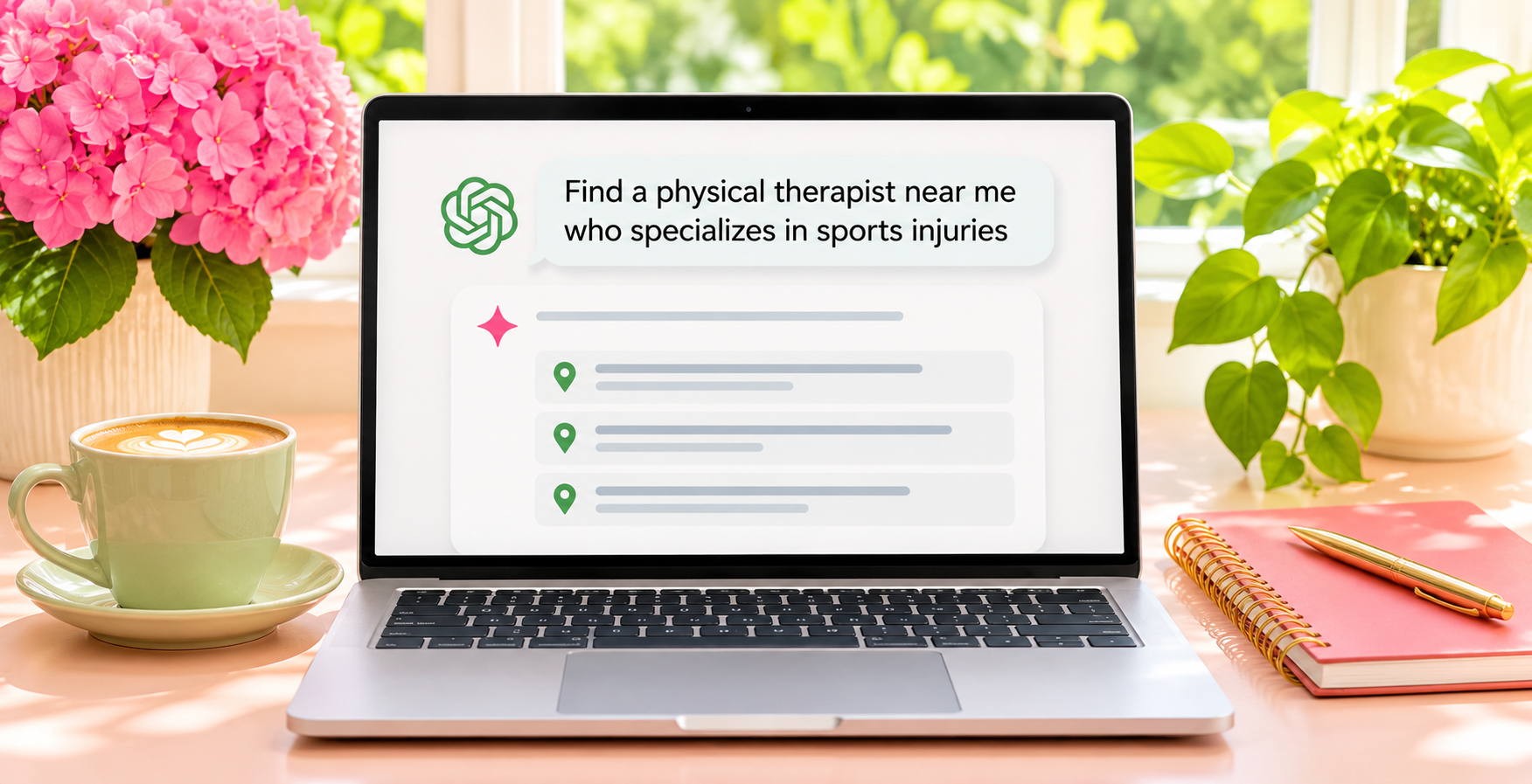
Let’s say someone’s looking for a physiotherapist. A few years ago, you’d probably have popped something into Google, opened a few websites, and spent a little time comparing your options. Now, you can ask ChatGPT to find you a physiotherapist who specialises in sports injuries, works within a few miles of your home, and offers appointments outside of working hours. You can even ask it to compare clinics, look at treatment costs, and explain what to expect during your first appointment.
Pretty convenient for the patient, but what does it mean for the clinics hoping to attract them?
More importantly, what can you be doing now to increase the chances of your practice being found through AI search?
The good news is that you don’t necessarily need to overhaul your entire website or throw everything you’ve learned about SEO out of the window. There are, however, a few things I’d recommend looking at.
1. Check that AI search tools can actually find you
This may seem like an obvious place to start, but there’s little point in investing in new website content if the tools you want to find it can’t actually access it. Just as Google uses crawlers to discover and index website content, ChatGPT uses a crawler called OAI-SearchBot to help find information for its search results.
Interestingly, OpenAI uses a separate crawler for training its AI models. So, if you’re uncomfortable with the idea of your website content being used for AI training, you can block that crawler (GPTBot) without blocking ChatGPT’s search crawler.
Google also explains that your pages need to be indexed and eligible to appear with a search snippet before they can be included as supporting links in its AI Overviews and AI Mode features.
If you have someone who looks after your website, I’d ask them to check a few things for you:
- Whether your website is blocking any relevant search crawlers
- Whether your important treatment and service pages are indexed by Google
- Whether your website’s security settings are preventing crawlers from accessing your content
- Whether your sitemap is up to date
- Whether important information is available as readable text rather than hidden away in images
It’s worth getting the technical side of things sorted before spending money on new content.
2. Make better use of the questions your patients ask you

One of the biggest opportunities I see for healthcare businesses when it comes to AI search is answering more of the questions their patients actually ask. Think about someone preparing for a hip replacement for example. They probably have a whole host of questions that go beyond how the procedure is performed and how long recovery takes.
They could be wondering whether they’ll be able to walk their dog afterwards, when they’ll be able to sleep on their side again, or how they’re going to manage living on their own during recovery.
Previously, finding answers to all those questions may have involved several different Google searches. Now, someone can ask an AI tool something like:
“I’m having a hip replacement next month, I’m 72, and I live alone. What should I be doing to prepare my home for recovery?”
Google’s AI search features can perform several related searches to help answer a more detailed question like this, bringing together information from different sources. The more useful, relevant information your website contains, the more opportunities there may be for your content to be discovered during those searches.
So, where do you find ideas for this kind of content?
I’d start by having a chat with the people who deal with your patients every day. Your receptionists, patient coordinators, nurses, and clinicians are probably answering some of the same questions week in, week out.
Ask them to jot those questions down over the course of a few weeks. You might just be surprised by how many potential blog topics, patient guides, and additions to your existing treatment pages come out of it.
You’ll also have the added benefit of being able to direct patients to those resources when the questions come up again.
3. Show off your clinical expertise a little more
I’ve worked with some incredibly experienced healthcare professionals over the years, and something that has often surprised me is how little of that experience comes across on their websites.
We’re talking about clinicians who have spent decades specializing in their fields, undertaken additional training, contributed to medical research, and treated thousands of patients, yet their website biography consists of a couple of generic paragraphs.
Then there are clinics with years’ worth of medical articles on their websites, without any indication of who has written them or checked the information for accuracy. If you’ve put years into developing your expertise, why not make a little more of it?
Google places a lot of importance on trust when it comes to content that could affect someone’s health or wellbeing. You’ll often see this discussed in relation to E-E-A-T, which stands for experience, expertise, authoritativeness, and trustworthiness.
While adding a clinician’s biography to your website isn’t going to magically get you featured in AI search results, there are plenty of good reasons to make your expertise more visible.
Here are a few things worth looking at:
- How detailed and up to date your clinician biographies are
- Whether qualifications, professional registrations, and specialist interests are easy to find
- Whether your medical articles identify their authors and clinical reviewers
- Whether you include references to reliable medical research and clinical guidance
- Whether readers can see when information was last reviewed
If you outsource your content writing, I’d also recommend having a clinical review process in place where appropriate.
Your writer can do the research and turn complicated medical information into something your patients will enjoy reading, while your clinical team can contribute their expertise and check the finished content for accuracy.
It’s a great way to make the most of both skill sets.
4. Give people information they can’t find on every other clinic’s website

If I had a dime for every time I’d come across a healthcare website promising exceptional patient care, innovative treatments, and a personalized approach, I’d probably have a rather healthy retirement fund by now!
Of course, these are all lovely things to offer your patients. The problem is that when every other clinic is saying exactly the same thing, it becomes difficult for someone to work out what makes your practice different.
What does your personalized approach involve? What do you do differently during a consultation? How do you decide which treatment is going to be most appropriate for someone?
Google encourages website owners to create original, useful content for its AI search features, and healthcare businesses have a wealth of knowledge they can draw on to do exactly that.
Let’s take a dermatology clinic as an example. You could publish a fairly standard article explaining the different treatments available for acne scarring. It’s a useful topic, but there are already thousands of articles covering it.
Alternatively, you could work with your dermatologist to create an article explaining how they assess different types of acne scars, why they may recommend one treatment over another, and why some patients may benefit from a combination of treatments.
You could even include some of the common misconception’s patients have when they first come in for a consultation.
Suddenly, you’ve got a much more interesting article that gives prospective patients a little insight into how your clinic approaches their care.
I’d love to see more healthcare businesses doing this. There’s so much knowledge sitting within clinics that could be turned into fantastic patient resources, and a lot of it never makes it beyond the consultation room.
5. Make it easier for AI to recommend you locally
While a lot of the discussion around AI search focuses on educational content, I think local searches deserve just as much attention from healthcare businesses.
Someone looking for a menopause specialist could ask ChatGPT to find a clinic within an hour of their home that offers private consultations, has experience treating women with premature menopause, and provides ongoing support.
Would your website contain enough information for an AI search tool to establish whether your clinic meets those requirements?
It’s worth looking at some of the more practical information on your website, including:
- Where your clinics are located
- Which treatments are available at each location
- Which clinicians work at each practice
- Whether you offer online consultations
- Whether patients need a referral
- Your consultation fees, where appropriate
- Your opening hours and appointment availability
- Any age restrictions or other eligibility requirements
- Parking, public transport, and accessibility information
If you have multiple clinics, giving each location its own dedicated page can be helpful, especially if the services or clinicians differ between locations. I’d also spend a little time checking your Google Business Profile, Bing Places listing, and any professional directories you’re listed in.
Have your opening hours changed? Is a clinician still listed who left the practice two years ago? Are there treatments you’ve introduced that haven’t made it onto your business listings yet?
These little details are easy to overlook when you’re busy running a practice, but they’re worth keeping on top of.
6. Find out what AI is already saying about your practice
When was the last time you searched for your own clinic using ChatGPT? If you haven’t done it yet, I’d recommend giving it a go. You might find the results quite interesting!
Spend a little time putting yourself in the shoes of a prospective patient and asking the kinds of questions they may ask when looking for a healthcare provider.
You could try:
- Which clinics in my area specialise in treating [condition]?
- Where can I find a private specialist for [treatment]?
- What treatments does [your clinic name] offer?
- How much does a consultation at [your clinic name] cost?
- What can I expect during my first appointment at [your clinic name]?
- Which clinics near me offer [specific service] without a referral?
Pay attention to which clinics are mentioned, which websites are referenced, and how accurately your own practice is represented.
If an AI tool is giving out incorrect information about your clinic, try to establish where that information has come from. It could be an outdated page on your website, an old business listing, or a third-party directory you haven’t looked at for years.
There are also some useful tools for monitoring AI search visibility. Google Search Console includes performance data from Google’s AI search features within its wider search reporting. Bing Webmaster Tools also has an AI Performance report that provides information about citations across supported Microsoft AI experiences.
You can use your website analytics to look for referral traffic from AI platforms, too. I’d recommend setting aside a little time each month to review these things. AI-generated answers can change from one search to the next, so I wouldn’t worry too much about individual results. It’s the patterns you notice over time that are likely to be more useful.
Where should you start if you have a limited content budget?
I appreciate that not every healthcare business has thousands of dollars to spend on developing its website content. You may have a small marketing budget, a website that hasn’t been updated in a while, and a fairly long list of other things that need your attention.
So, rather than trying to do everything at once, I’d start with your five most important services. Look at each of those service pages and ask yourself the following questions:
| Question | What you could do |
| Does the page answer the questions patients commonly ask? | Add more detailed explanations and relevant FAQs. |
| Is all the medical information still accurate? | Arrange a clinical review and update outdated information. |
| Does it demonstrate our clinical expertise? | Introduce the clinicians providing the treatment and link to their biographies. |
| Does it explain what makes our approach different? | Include specific information about your consultations, treatments, and patient care. |
| Is there enough practical information? | Add relevant details about costs, appointments, eligibility, and aftercare. |
| Are there other resources patients might find helpful? | Create supporting articles and guides and link to them from the service page. |
Once you’ve worked through those five pages, you can start looking at the supporting content you have for each service. You may already have some perfectly good articles that just need a little more detail, updated references, or input from one of your clinicians.
Refreshing existing content can be a much more manageable starting point than commissioning an entirely new collection of articles.
Do you really need a separate AI search strategy?
There’s a lot of talk about AI search optimization at the moment, and I’m sure we’ll see plenty of new services popping up promising to get businesses featured in AI-generated answers. I’d be a little cautious about anyone offering guarantees.
Google’s own guidance explains that the usual SEO principles still apply to its AI search features. There’s no special AI markup you need to add to your website or secret way of writing your content that guarantees it’ll be picked up.
What I do think is worth investing in is better, more comprehensive healthcare content.
For years, many businesses have been encouraged to publish a certain number of blogs each month, often covering fairly generic topics because they have a decent search volume.
I’d love to see more of that budget going towards detailed patient guides, clinician-led articles, comprehensive treatment pages, and resources that answer the questions people genuinely want answers to.
AI search may be changing how people discover healthcare providers, but those people still have decisions to make. They want to understand their options, feel comfortable with the treatment they’re considering, and find a healthcare professional they can trust.
A good collection of website content can help them with all those things, however they happen to find you.
Need a little help with your healthcare website content?
If reading this has made you realize there are a few gaps in your website content, I’d love to help you fill them. I’ve spent much of the past twenty years writing for healthcare businesses, helping them turn their clinical knowledge into accessible, engaging content that their patients can put to good use.
Whether you’d like to give your existing treatment pages a refresh, develop a collection of patient guides, or come up with some more interesting ideas for your blog, feel free to drop me an email.
We can have a chat about what you’ve already got, what you’d like to achieve, and where your content budget might be best spent.

Leave a Reply